What are technical manufacturing translation services? Technical manufacturing translation services accurately convert Standard Operating Procedures (SOPs), safety protocols, machine operating manuals, and hazardous material guidelines into a worker’s primary language. INGCO International combines ISO 17100-certified workflows with industry-specialized Wordologists™ to eliminate factory floor hazards, reduce machinery downtime, and ensure complete OSHA safety compliance across 200+ languages.
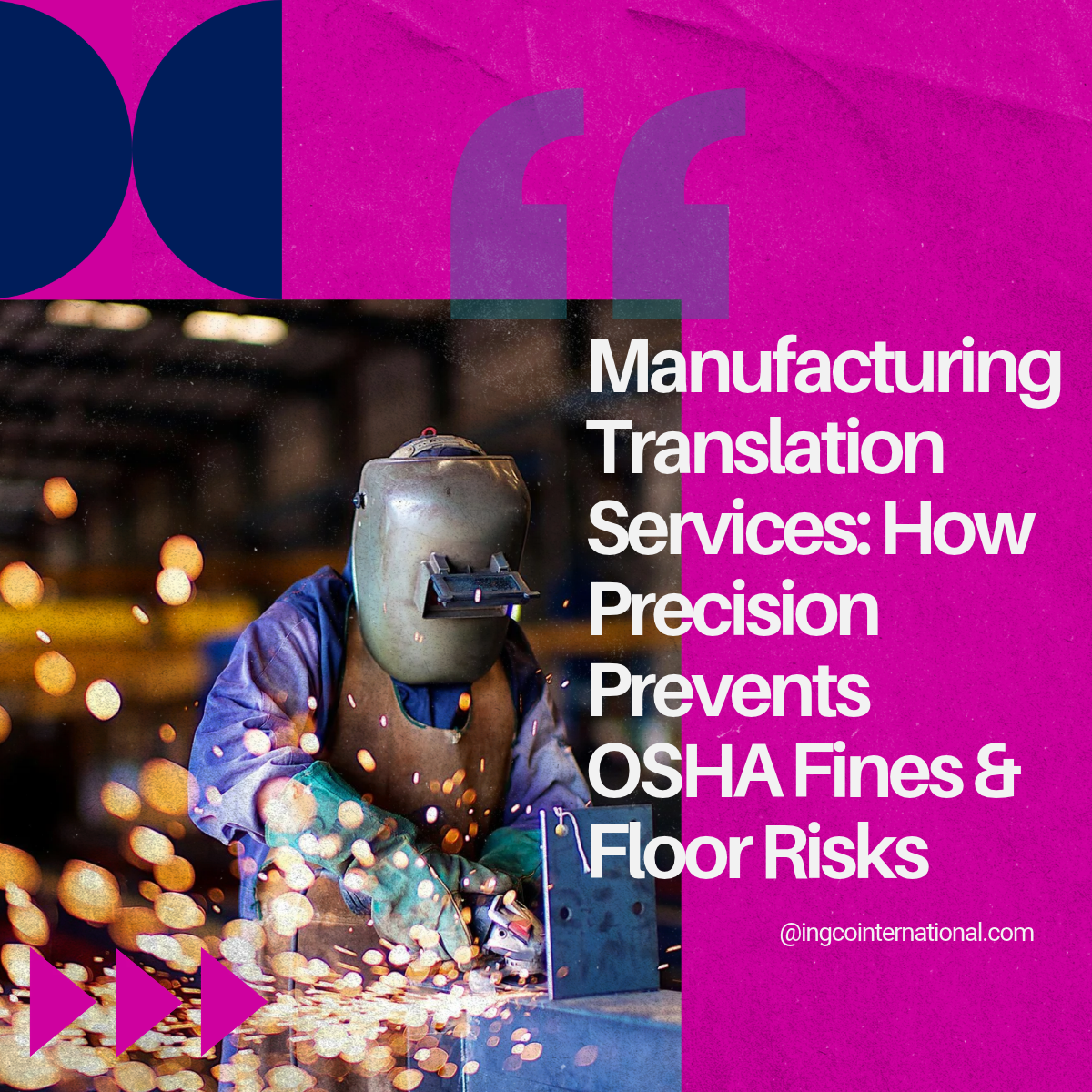
Manufacturing Translation Services: How Precision Prevents OSHA Fines & Floor Risks
Clear communication is essential on a busy factory floor. Modern equipment, automated lines, and chemical processing leave zero room for error. Yet, many manufacturing facilities now employ an increasingly multilingual workforce. Relying on informal translation methods to convey life-safety protocols creates immediate risk.
Providing machinery manuals and operating procedures in English alone creates operational bottlenecks. It also exposes your plant to immense regulatory liability. Federal workplace safety regulations require clear communication. Under OSHA standards, employers must provide safety training and hazard warnings in a language workers clearly understand.
At INGCO International, we partner directly with plant managers and operations directors. We implement human-led, tech-enabled language access strategies. Our solutions keep your shop floor safe, productive, and fully compliant.
The High Cost of Language Barriers on the Factory Floor
Many plants rely on informal “bilingual buddy systems.” In these setups, fluent workers informally translate machinery instructions for non-English peers. This practice creates severe vulnerabilities across your shop floor.
1. OSHA Non-Compliance & Severe Penalties
OSHA requires employers to present safety information clearly. Inspections often reveal workers operating equipment without translated SOPs or Safety Data Sheets. When this happens, regulatory penalties accumulate rapidly. Fines for repeat or willful violations can easily exceed six figures per incident. Professional manufacturing translation services eliminate this liability. They establish an auditable record of fully compliant safety documentation.
2. Micro-Stoppages and Machinery Downtime
Linguistic confusion does more than cause physical injuries. It directly impairs daily operational throughput. A machine operator might hesitate during an automated changeover. They might misinterpret an error code on an HMI panel. They might even apply a lubrication schedule incorrectly. The result is unplanned equipment downtime. Precision translation ensures technical instructions are clear. It protects your personnel and your equipment investments.
3. Compromised Quality and Waste
Manufacturing consistency requires identical execution across every shift. Shift A might follow fully translated SOPs. Shift B might rely on verbal secondhand translation. In this scenario, component defects inevitably rise. Standardized technical translation guarantees uniform execution. Assembly protocols, torque specifications, and tolerance limits remain exact across your entire organization.
Critical Manufacturing Documents Requiring Professional Translation
A complete plant safety strategy covers every point of contact between workers and machinery:
- Standard Operating Procedures (SOPs): Clear, step-by-step instructions for machine operations, Lockout/Tagout (LOTO) protocols, and maintenance.
- Safety Data Sheets (SDS) & Labels: Exact translations of chemical properties, exposure limits, and spill responses adhering to GHS standards.
- Workplace Hazard Signage: Direct, high-visibility signage placed near high-voltage areas, automated robot cells, and crane paths.
- Incident Report Forms: Standardized documentation for workers to report near-misses, equipment errors, or injuries accurately.
Real-World Scenario: Eliminating Misinterpretation in LOTO Protocols
Consider a multi-line food processing facility operating 24/7. Their workforce speaks English, Spanish, and Somali. During routine maintenance on a packaging machine, an operator attempted to clear a jam. They failed to execute the multi-step Lockout/Tagout (LOTO) protocol correctly.
The facility investigated the incident. The primary LOTO policy document was on file in English. However, the physical placard mounted on the machine used ambiguous machine-translated text in Somali. The automated tool translated “De-energize main breaker” into a generic phrase meaning “Turn off the switch.” Because of this error, the worker turned off a local toggle instead of isolating the main power breaker.
The facility partnered with INGCO International to solve the problem. We replaced all machine placards with precise, human-verified technical translations. Our team audited the plant’s entire SOP library. We standardized critical safety verbs across all languages spoken on the floor. Zero LOTO safety incidents have occurred since implementation.
Why Technical Accuracy Demands Specialized Wordologists™
Automated translation engines process grammar and basic vocabulary. However, they lack industrial context. In manufacturing, a word like “lead” has multiple meanings. It can mean a heavy metal, a wire connection, or a production lead time. Each context requires a distinct translation.
INGCO’s network of Wordologists™ includes expert linguists in engineering, safety, and plant operations. Combined with our ISO 17100 and ASTM quality certifications, The INGCO Way delivers 100% contextual accuracy through multi-stage human review.
Protect your workforce, reduce floor risks, and guarantee safety compliance today. Contact INGCO International for a complimentary manufacturing project analysis.